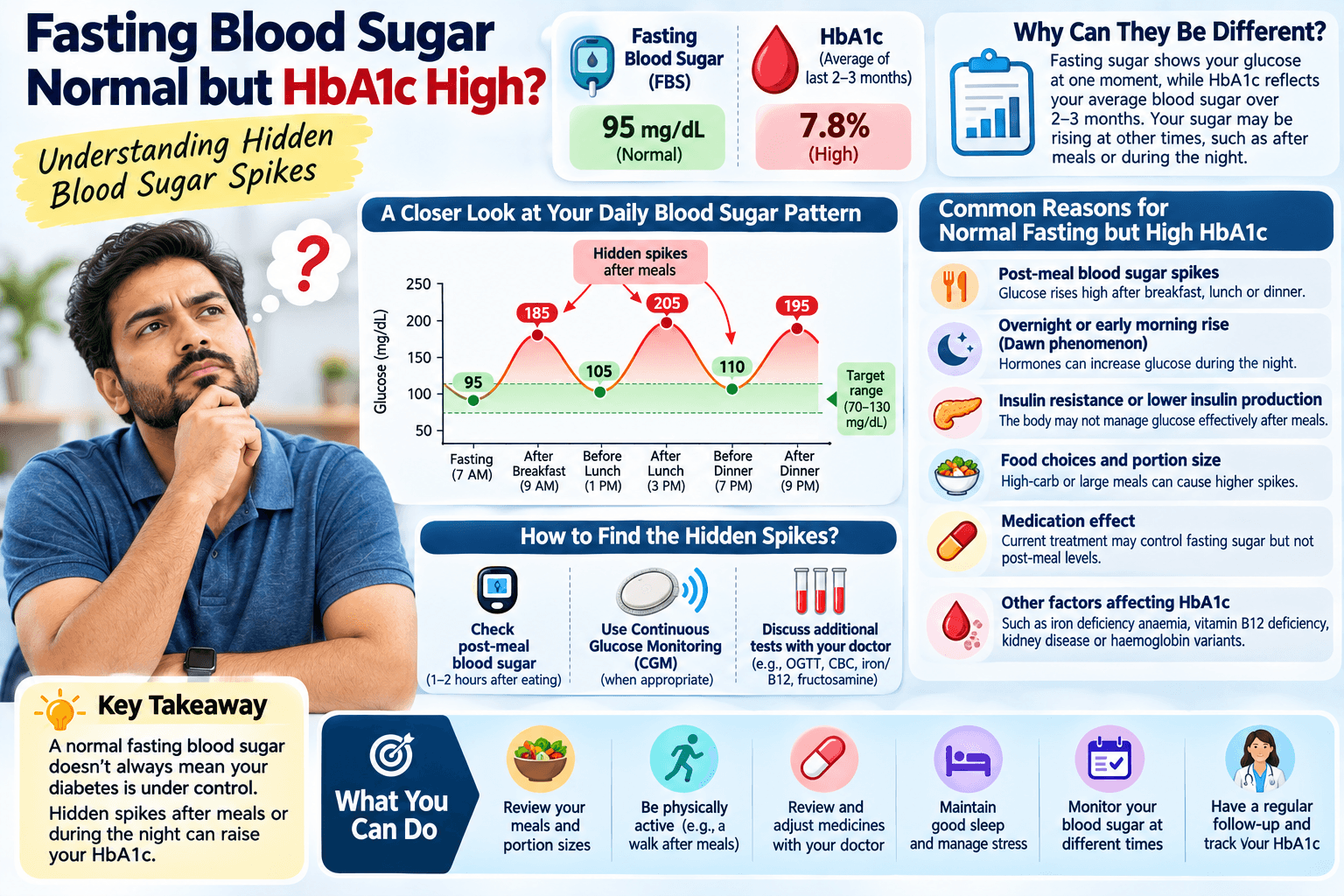
Fasting Blood Sugar Normal but HbA1c High? Understanding Hidden Blood Sugar Spikes
You check your fasting blood sugar in the morning, and the result looks perfectly fine. But when your doctor reviews your HbA1c report, the number is higher than expected.
How can both results be different?
This is a common situation among people with Type 2 diabetes and those being evaluated for diabetes. It can be confusing, especially when you are following your medication schedule, watching what you eat, and trying to maintain a healthy lifestyle.
The explanation may be that your fasting blood sugar is only showing one moment in your day, while HbA1c reflects your average glucose levels over approximately the previous two to three months.
Your blood sugar may be rising after meals, increasing during the night, or fluctuating at other times when you are not checking it.
These changes are sometimes called hidden blood sugar spikes because they may go unnoticed with occasional fasting glucose testing.
Let's understand why this happens, what it means for your health, and how you can identify the underlying problem.
1. Why Can Fasting Blood Sugar Be Normal but HbA1c High?
First, it is important to understand that fasting glucose and HbA1c measure different aspects of blood sugar control.
Fasting Blood Sugar (FBS) measures glucose in your bloodstream after at least eight hours without food or caloric drinks.
It tells your doctor what your glucose level looks like at that particular time, usually in the morning.
HbA1c measures the percentage of haemoglobin in your red blood cells that has glucose attached to it. Since red blood cells circulate for approximately three months, the test provides an estimate of your average glucose exposure over the preceding two to three months.
For example:
- Your fasting blood sugar may be 95 mg/dL.
- Your post-meal glucose may rise significantly.
- Your glucose may remain elevated for several hours after eating.
- Your morning fasting reading may return to a relatively normal level.
If these elevations occur repeatedly, they can contribute to a higher HbA1c even when your fasting readings appear satisfactory.
This is why looking at fasting glucose alone may not provide a complete picture of diabetes management.
2. Hidden Post-Meal Blood Sugar Spikes
One of the most common explanations for this mismatch is post-meal hyperglycaemia, which means elevated blood glucose after eating.
When you eat, carbohydrates are broken down into glucose and enter your bloodstream.
Normally, insulin helps your body use this glucose for energy. However, in Type 2 diabetes, insulin resistance and reduced insulin production can make it difficult to manage the increase.
As a result, your blood sugar may rise significantly after breakfast, lunch, or dinner.
Consider this example:
Time
Illustrative glucose reading
Before breakfast
95 mg/dL
After breakfast
185 mg/dL
Before lunch
105 mg/dL
After lunch
205 mg/dL
Before dinner
110 mg/dL
After dinner
195 mg/dL
Next morning fasting
98 mg/dL
These are illustrative readings, not an individual diagnosis or a prediction of HbA1c.
Notice that the fasting readings look relatively good, but glucose rises considerably after meals.
If this pattern occurs regularly, it may contribute to an elevated HbA1c.
The important takeaway: A normal fasting reading does not guarantee that your blood sugar is controlled throughout the day.
3. Your Breakfast, Lunch, and Dinner May Be Causing Glucose Spikes
Your food choices and portion sizes can significantly influence post-meal glucose levels.
In many Indian households, meals commonly include rice, chapati, dosa, idli, poha, upma, and other carbohydrate-rich foods.
These foods are not necessarily unhealthy or forbidden for people with diabetes. However, the amount consumed, preparation method, and combination with protein, fibre, and fats can influence the glucose response.
For example:
- A large serving of white rice may produce a substantial glucose rise.
- Breakfast consisting mainly of refined carbohydrates may cause an early morning spike.
- Sugary tea, coffee, fruit juices, and sweetened beverages can add significant carbohydrates.
- Large dinner portions may contribute to elevated glucose levels later in the evening.
A person may have a normal fasting reading the following morning without realising that glucose remained elevated for several hours after dinner.
What can help?
Pay attention to portion sizes, include vegetables and adequate protein in meals, choose fibre-rich carbohydrate sources, and observe how different meals affect your glucose.
A registered dietitian or diabetes educator can help develop an eating plan that suits your preferences and glucose patterns.
4. Your Blood Sugar May Be Rising During the Night
Not all glucose spikes happen after meals.
Some people experience elevated glucose during the early morning hours because of a phenomenon known as the dawn phenomenon.
During the early morning, hormones such as cortisol and growth hormone signal the liver to release glucose to prepare the body for waking up.
In people with diabetes, the body's insulin response may not be sufficient to manage this increase.
Other overnight patterns can also contribute to morning glucose changes, including glucose remaining elevated after dinner or insufficient overnight glucose control.
A single fasting measurement cannot explain what happened throughout the night.
Continuous glucose monitoring or appropriately timed glucose checks may help identify these patterns.
5. Your Body May Not Be Producing or Using Insulin Effectively
Type 2 diabetes involves two important problems:
- Insulin resistance: The body's cells do not respond effectively to insulin.
- Reduced insulin production: The pancreas may gradually become less able to produce enough insulin.
These problems can affect glucose control differently throughout the day.
Some people may have reasonably controlled fasting glucose but struggle to manage glucose after meals.
This can happen because the body's insulin response after eating is insufficient to handle the incoming glucose.
As diabetes progresses, these patterns may become more noticeable.
If your HbA1c remains elevated despite apparently normal fasting readings, your doctor may need to assess whether your current treatment adequately controls post-meal glucose.
6. You May Not Be Checking Your Blood Sugar at the Right Times
Many people with diabetes check their glucose only once a day, usually before breakfast.
While fasting glucose monitoring is useful, it cannot show what happens after lunch, dinner, exercise, or during sleep.
For example, someone may have:
- Normal fasting glucose.
- High glucose one to two hours after lunch.
- Elevated readings after dinner.
- Glucose fluctuations during the night.
If you only measure your blood sugar in the morning, these patterns may remain undetected.
Depending on your treatment and individual circumstances, your doctor may recommend structured glucose monitoring at different times of the day.
For many non-pregnant adults with diabetes, a commonly used post-meal target is below 180 mg/dL, measured one to two hours after the beginning of a meal. However, individual targets can differ.
7. Could Your HbA1c Be Incorrectly Elevated?
Sometimes, the difference between fasting glucose and HbA1c is not entirely explained by hidden glucose spikes.
Certain medical conditions can affect how HbA1c reflects actual average glucose.
For example:
Iron deficiency anaemia: Iron deficiency can sometimes result in a falsely elevated HbA1c.
Vitamin B12 deficiency: Depending on its effect on red blood cell turnover, it may influence HbA1c interpretation.
Haemoglobin variants: Conditions such as thalassaemia and other haemoglobin disorders can affect certain HbA1c measurement methods.
Kidney disease: Some forms of kidney disease, particularly when associated with anaemia or altered red blood cell turnover, can make HbA1c less reliable.
This is particularly relevant when HbA1c appears significantly higher than expected from repeated glucose measurements.
Your doctor may recommend additional investigations, such as a complete blood count, iron studies, or other tests depending on your medical history.
Do not assume that an elevated HbA1c is a laboratory error without investigating the possible causes.
8. How Can Continuous Glucose Monitoring (CGM) Help?
This is where Continuous Glucose Monitoring can provide valuable information.
A CGM device uses a small sensor worn on the body to measure glucose in the fluid beneath the skin throughout the day and night.
Instead of giving you only occasional readings, it creates a continuous glucose profile.
It can help identify:
- Glucose spikes after breakfast, lunch, and dinner.
- How long glucose remains elevated after meals.
- Overnight glucose increases or decreases.
- Early morning glucose patterns.
- The effect of exercise on glucose.
- Glucose variability throughout the day.
- Time spent within and above your target range.
For example, imagine that your fasting glucose is consistently around 95–105 mg/dL, but your CGM shows repeated increases to 190–220 mg/dL after meals.
This information may help explain why your HbA1c is higher than expected.
CGM is not necessary for everyone with Type 2 diabetes, but it may be useful when glucose patterns are unclear or when treatment decisions require more detailed information.
9. What Other Tests Can Help Explain the Difference?
If fasting glucose and HbA1c do not match, your doctor may recommend additional assessments.
Post-meal blood glucose: Measures glucose after eating and helps identify post-meal elevations.
Oral Glucose Tolerance Test (OGTT): Assesses how the body handles a measured glucose drink. It can help identify impaired glucose tolerance or diabetes in appropriate diagnostic situations.
Continuous Glucose Monitoring: Provides information about glucose patterns throughout the day and night.
Complete Blood Count (CBC): Helps identify anaemia and other blood-related conditions that may affect HbA1c interpretation.
Iron and vitamin B12 studies: May be considered when nutritional deficiencies or anaemia are suspected.
Fructosamine: Provides an estimate of average glucose over approximately the previous two to three weeks and may be useful in selected situations where HbA1c is unreliable.
Your doctor will decide which tests are appropriate based on your existing reports and medical history.
10. What Should You Do If Your Fasting Sugar Is Normal but HbA1c Is High?
Do not ignore the elevated HbA1c simply because your fasting glucose looks normal.
Instead, focus on understanding the difference.
Here are some practical steps:
Step 1: Review your HbA1c trend
Compare your latest result with previous reports. Is it gradually increasing or consistently above your individual target?
Step 2: Check post-meal glucose
Ask your doctor whether you should monitor glucose one to two hours after the beginning of meals.
Step 3: Review your food habits
Look at portion sizes, carbohydrate intake, sugary drinks, and the timing of your meals.
Step 4: Evaluate overnight glucose patterns
If morning readings and HbA1c do not match, discuss whether overnight monitoring or CGM could provide useful information.
Step 5: Review your medication
Your current medicines may control fasting glucose without adequately controlling post-meal elevations. Your doctor can assess whether your treatment needs adjustment.
Step 6: Investigate possible HbA1c interference
If the glucose readings consistently do not match HbA1c, discuss whether anaemia, haemoglobin variants, kidney disease, or other conditions could be affecting the result.
Never change your diabetes medication or insulin dose based on an isolated reading without appropriate medical guidance.
When Should You Take This Difference Seriously?
An occasional difference between fasting glucose and HbA1c does not necessarily indicate a serious problem.
However, it deserves attention when:
- HbA1c continues to increase despite apparently normal fasting readings.
- Post-meal glucose is repeatedly elevated.
- You experience unexplained fatigue, increased thirst, or frequent urination.
- Your glucose readings vary significantly throughout the day.
- Your treatment appears to be controlling only certain parts of the day.
- HbA1c and glucose measurements remain consistently inconsistent.
If diabetes is being diagnosed for the first time and HbA1c and fasting glucose give different results, your doctor may repeat the test that is above the diagnostic threshold and investigate possible interference before confirming the diagnosis.
The Bottom Line
A normal fasting blood sugar does not always mean your diabetes is under control.
Your glucose may rise after meals, fluctuate during the night, or remain elevated at times when you are not checking it.
This is why HbA1c and fasting glucose should be understood together rather than treated as interchangeable tests.
If your fasting glucose looks normal but your HbA1c remains high, the next step is not to panic or automatically increase your medication.
It is to identify the hidden glucose patterns, understand why they are occurring, and work with your doctor on an appropriate management plan.
Don't just check your morning sugar. Understand your glucose throughout the day. Because better diabetes management starts with knowing the complete picture.
Book an Appointment
Dr. Sayanti Banerjee
Consultant Physician & Diabetologist
Quest Diabetic Clinic & Diagnostic CentreShankar Plaza, 1st FloorOpposite Idgha High SchoolMurgasol, Asansol – 713303
Phone: 8972775902 / 8016200778
Website: www.questdiabeticclinic.com