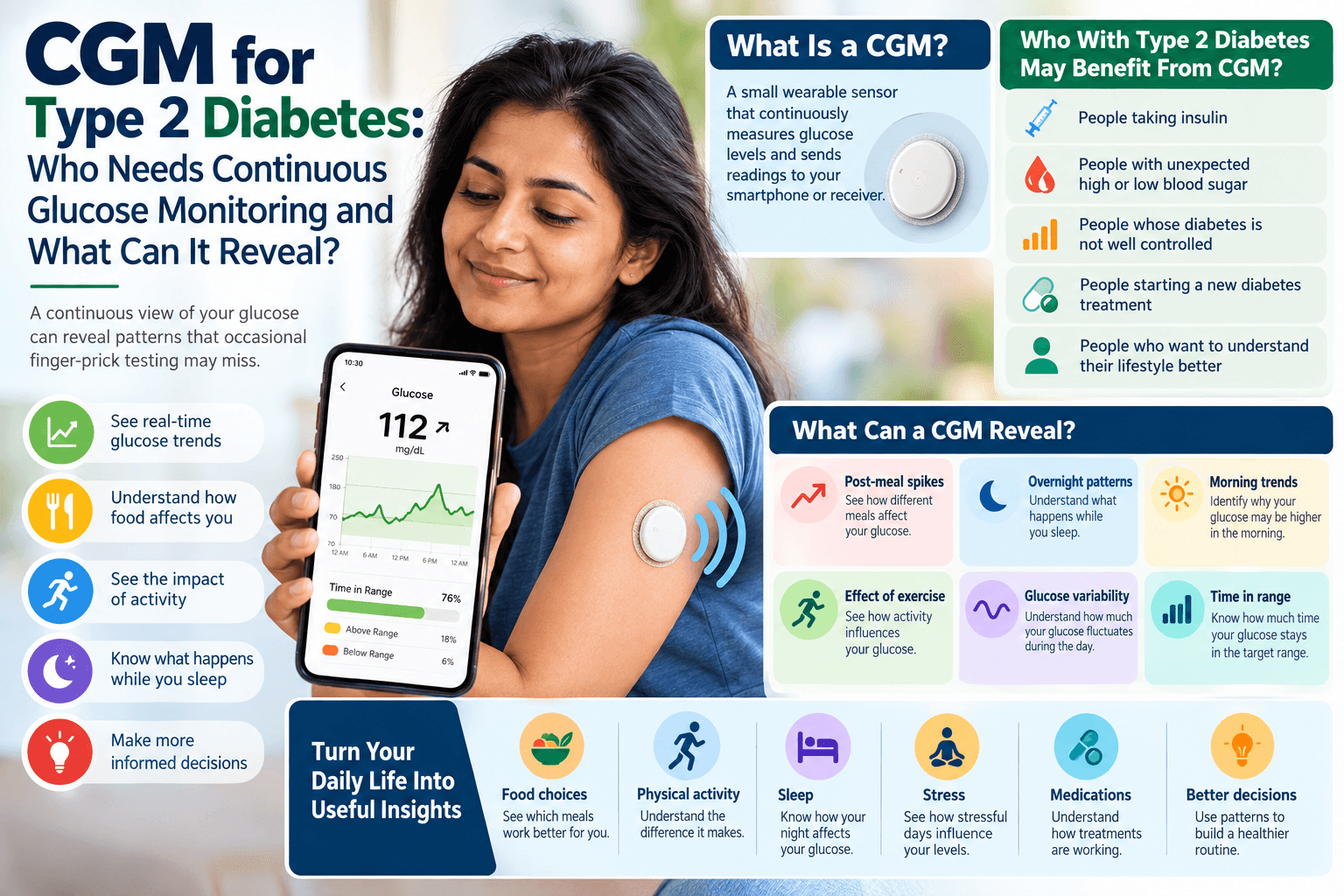
CGM for Type 2 Diabetes: Who Needs Continuous Glucose Monitoring and What Can It Reveal?
For many people with Type 2 diabetes, checking blood sugar means taking out a glucometer, pricking a finger, getting a number, and moving on with the day.
But blood sugar does not stay at one level throughout the day.
It changes after meals, during exercise, after medication, during periods of stress, and even while you sleep.
This is where Continuous Glucose Monitoring (CGM) can provide a very different view of diabetes management.
Instead of giving you occasional readings, a CGM continuously tracks glucose levels and creates a picture of how your blood sugar behaves throughout the day and night.
For people with Type 2 diabetes, this information can reveal patterns that a few daily finger-prick readings may never show.
What Is a CGM?
A Continuous Glucose Monitor is a small wearable device that measures glucose in the fluid just beneath the skin.
A sensor is usually worn on the body and communicates glucose readings to a receiver or smartphone. Depending on the device, readings can be updated every few minutes.
Unlike a traditional glucometer, which tells you your glucose level at one particular moment, a CGM creates a continuous glucose profile.
You can see whether your glucose is:
- Rising after a particular meal
- Remaining high for several hours
- Dropping after exercise
- Falling too low during the night
- Increasing in the morning
- Fluctuating significantly throughout the day
The result is not just a collection of numbers—it is a picture of your glucose patterns.
Why Can CGM Be Useful in Type 2 Diabetes?
Type 2 diabetes is often managed using a combination of diet, physical activity, medication, weight management, and regular monitoring.
But two people with the same HbA1c can have very different glucose patterns.
For example, one person may have glucose levels that remain relatively stable throughout the day.
Another person may experience significant spikes after meals followed by long periods of elevated glucose.
Their average numbers may look similar, but their daily glucose patterns can be very different.
CGM helps make those patterns visible.
The American Diabetes Association's 2026 Standards of Care recommend CGM for adults with diabetes who use insulin, people using non-insulin treatments that can cause hypoglycemia, and people on diabetes treatments where CGM can help with management.
That means CGM is no longer viewed as technology reserved exclusively for people with Type 1 diabetes.
Who With Type 2 Diabetes May Benefit Most From CGM?
CGM may be particularly useful in several situations.
1. People Taking Insulin
This is one of the clearest groups that can benefit from CGM.
Insulin can cause blood glucose to fall too low, and CGM can help identify falling glucose levels and provide alerts on compatible devices.
It can also help people understand how insulin doses, meals, activity, and other factors affect glucose levels.
For people using insulin, the ADA recommends CGM from diabetes onset and as close to daily use as possible for maximum benefit.
2. People Experiencing Unexpected High or Low Blood Sugar
Some people experience glucose fluctuations without realizing it.
For example, a person may feel tired in the afternoon but not realize that their glucose is rising significantly after lunch.
Another person may experience overnight glucose drops without waking up.
CGM can help identify these patterns and provide information that can be discussed with a healthcare professional.
3. People Whose Diabetes Is Not Well Controlled
If HbA1c remains above the individual's target despite treatment, a CGM can help answer an important question:
When exactly is the glucose going high?
Is it:
- After breakfast?
- After lunch?
- After dinner?
- During the night?
- Early in the morning?
- After certain foods?
- On inactive days?
- When medication wears off?
Finding the pattern can make diabetes management more targeted.
4. People Starting a New Diabetes Treatment
A CGM can sometimes provide useful information when treatment is being changed.
Instead of waiting several weeks for another HbA1c result, glucose patterns can be observed over a shorter period.
This can help healthcare professionals understand how a person's glucose is responding to the overall treatment plan.
5. People Who Want to Understand Their Lifestyle Better
CGM can also make lifestyle changes more tangible.
You may already know that exercise is beneficial.
But seeing what happens to your glucose after a walk compared with sitting after a meal can make that connection much clearer.
Similarly, CGM can help reveal how different meals affect your glucose profile.
The objective isn't to become obsessed with every glucose number.
The objective is to understand patterns and make useful changes.
What Can a CGM Actually Reveal?
This is where CGM becomes particularly interesting.
1. Post-Meal Glucose Spikes
You may check your glucose before eating and find that it is within your target.
That doesn't necessarily tell you what happens afterward.
A CGM can show the rise following a meal and how long it takes for glucose to return toward your usual levels.
This can help identify meals that produce particularly large or prolonged glucose increases.
2. Overnight Glucose Patterns
Your glucose does not stop changing when you go to sleep.
A CGM can show overnight patterns that would be difficult to identify with occasional finger-prick testing.
It can reveal whether glucose remains relatively stable, rises overnight, or falls during certain periods.
3. Morning Glucose Trends
Some people consistently notice higher glucose readings in the morning.
A CGM can help show what is happening during the hours before waking rather than providing only a single morning measurement.
That additional context can be useful when discussing glucose patterns with a healthcare professional.
4. The Effect of Exercise
Exercise can influence glucose levels in different ways depending on the type, duration, intensity, timing, medications, and individual response.
With CGM, you can observe how your glucose responds before, during, and after physical activity.
Over time, this can help you understand your personal patterns.
5. Glucose Variability
Two people may have the same average glucose but very different levels of fluctuation.
One may remain relatively stable.
Another may move repeatedly between high and low levels.
CGM allows clinicians to assess this variability using standardized metrics.
This is one reason CGM data can provide information beyond HbA1c alone.
What Is "Time in Range"?
One of the most useful CGM measurements is Time in Range (TIR).
Instead of asking only:
"What is my average blood sugar?"
TIR asks:
"How much of my day is my glucose within my target range?"
For many adults with diabetes, the commonly used CGM range is 70–180 mg/dL.
The ADA's 2026 guidance lists a general goal of spending more than 70% of time in this range for many adults, although individual targets can be different.
TIR provides a more detailed picture of daily glucose control.
For example, two people could have a similar HbA1c but very different amounts of time spent within range.
That difference can be clinically meaningful.
CGM Can Also Show Time Above and Below Range
CGM reports can provide several useful measurements, including:
Time in Range (TIR)
How much time glucose remains within the target range.
Time Above Range (TAR)
How much time glucose remains above the target range.
Time Below Range (TBR)
How much time glucose remains below the target range.
Glucose variability
How much glucose fluctuates over time.
These measurements allow healthcare professionals to look beyond a single average number and understand the overall glucose profile.
CGM vs HbA1c: Are They the Same?
No.
HbA1c and CGM answer different questions.
HbA1c provides an estimate of average blood glucose over roughly the previous 2–3 months.
CGM provides detailed information about glucose patterns over the period the device is worn.
Think of it this way:
HbA1c = the overall summary
CGM = the detailed day-to-day picture
Both can be useful.
CGM should not be viewed as a replacement for all other diabetes assessments.
Does Everyone With Type 2 Diabetes Need a CGM?
No.
CGM can be extremely useful for some people, but it isn't automatically necessary for every person with Type 2 diabetes.
The decision depends on factors such as:
- Whether you use insulin
- Risk of hypoglycemia
- Current glucose control
- Diabetes medications
- Frequency of glucose fluctuations
- Ability and willingness to use the device
- Cost and access
- Personal preferences
- Whether the information will actually change management
The ADA specifically recommends that the choice of CGM device and method should be individualized according to a person's circumstances, preferences, and needs.
Can CGM Be Used for a Short Period?
Yes.
CGM does not always have to mean wearing a sensor indefinitely.
In some situations, a short-term or professional CGM assessment can provide useful information about glucose patterns.
The ADA notes that periodic or professional CGM can be helpful when continuous use is not possible.
For example, a short monitoring period may help answer questions such as:
"Why is my sugar high despite taking my medication?"
"Which meals are causing the biggest spikes?"
"What happens to my glucose overnight?"
"How does my exercise routine affect my glucose?"
Once the pattern is understood, the treatment and lifestyle plan can be adjusted accordingly.
Does Using a CGM Mean You Never Need a Finger-Prick Test?
Not necessarily.
CGM measures glucose in interstitial fluid rather than directly measuring blood glucose.
There can be differences between sensor readings and blood glucose readings, particularly in certain situations.
The CDC notes that people using CGM may still need access to a blood glucose meter and should follow their healthcare team's guidance regarding when confirmatory finger-stick testing is appropriate.
CGM and traditional glucose monitoring can therefore complement each other.
The Biggest Benefit: Turning Numbers Into Information
The real value of CGM is not simply seeing more numbers.
It is understanding why those numbers change.
Imagine discovering that:
Your breakfast causes a large glucose rise.
A 20-minute walk after dinner reduces your post-meal glucose increase.
Your glucose remains elevated for several hours after certain meals.
Your overnight glucose follows a consistent pattern.
Your medication is controlling fasting glucose but not certain post-meal elevations.
These insights can turn diabetes management from guesswork into a more informed, personalized process.
CGM Can Change the Conversation Around Diabetes
Traditional glucose monitoring often gives you isolated points.
CGM provides a story.
Instead of saying:
"My sugar was 145 this morning."
You can begin to ask:
"Why does my glucose rise every morning?"
Instead of:
"My sugar was normal before dinner."
You can ask:
"What happens to my glucose during the three hours after dinner?"
Instead of:
"My HbA1c is higher than expected."
You can ask:
"Where are the patterns driving my overall glucose exposure?"
That shift can make diabetes management more personalized.
The Bottom Line
Continuous Glucose Monitoring can provide a window into what is happening to your glucose throughout the day—not just at the moment you test it.
For people with Type 2 diabetes, CGM can reveal:
- Hidden glucose spikes
- Overnight patterns
- Low-glucose episodes
- Effects of meals
- Responses to exercise
- Glucose variability
- Time spent in and above the target range
- Patterns that may help guide treatment decisions
But the goal is not to chase every number on the screen.
The goal is to use the information to understand your diabetes better and make smarter, sustainable decisions about treatment, food, activity, and daily life.
Book an Appointment
Dr. Sayanti Banerjee
Consultant Physician & Diabetologist
Quest Diabetic Clinic & Diagnostic CentreShankar Plaza, 1st FloorOpposite Idgha High SchoolMurgasol, Asansol – 713303
Phone: 8972775902 / 8016200778
Website: www.questdiabeticclinic.com