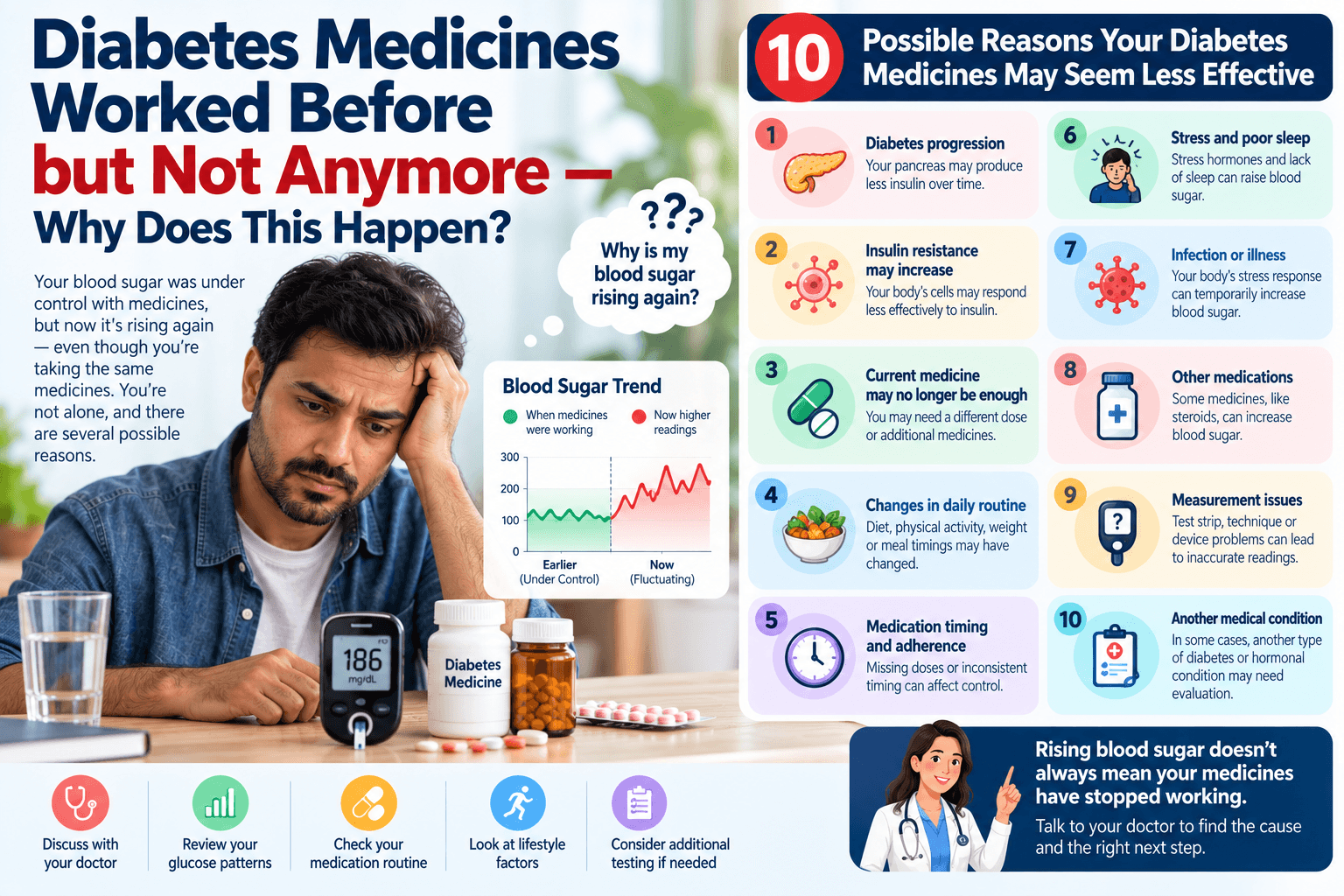
Diabetes Medicines Worked Before but Not Anymore — Why Does This Happen?
When you were first diagnosed with Type 2 diabetes, your medicines may have brought your blood sugar under control. Your fasting glucose improved, your HbA1c decreased, and your daily readings became more predictable.
But months or years later, something changes.
Your fasting blood sugar starts rising again. Post-meal readings remain high despite taking your prescribed medicines. Your HbA1c gradually increases, even though you haven't deliberately changed your routine.
Naturally, you may wonder: Have my diabetes medicines stopped working?
This is a common concern among people living with Type 2 diabetes. However, rising blood sugar does not necessarily mean that a medicine has completely stopped working or that you have done something wrong.
Type 2 diabetes can change over time, and several factors can affect how well your treatment controls glucose.
Understanding these factors can help you have a more productive conversation with your doctor and determine what needs to change.
1. Type 2 Diabetes Can Progress Over Time
One of the most important reasons diabetes medicines may become less effective is the natural progression of Type 2 diabetes.
In the early stages, the pancreas may compensate for insulin resistance by producing more insulin. Over time, however, the insulin-producing beta cells can gradually lose their ability to meet the body's needs.
As a result, glucose levels may begin to rise even when you continue taking your medicines consistently.
A medicine that once provided sufficient glucose control may no longer be enough on its own.
What this means: Your diabetes treatment may need to evolve as your condition changes. Needing a different dose or an additional medicine does not mean that your previous treatment was a failure.
2. Your Body May Be Becoming More Resistant to Insulin
Insulin helps glucose move from the bloodstream into cells, where it can be used for energy.
In Type 2 diabetes, the body's cells may respond less effectively to insulin. This is known as insulin resistance.
Insulin resistance can be influenced by several factors, including:
- Increased abdominal fat
- Reduced physical activity
- Changes in body weight
- Poor sleep
- Certain hormonal conditions
- Some medications and illnesses
When insulin resistance increases, the body may struggle to keep glucose levels within the desired range.
What you can discuss with your doctor: Whether changes in your weight, activity level, sleep, or other health conditions could be contributing to your rising glucose levels.
3. Your Current Medication May No Longer Be Enough
Different diabetes medicines work through different mechanisms.
Some reduce the amount of glucose produced by the liver. Others improve insulin sensitivity, increase insulin release, reduce glucose absorption, or help the kidneys remove excess glucose through urine.
As Type 2 diabetes progresses, one medication may not provide enough control to address all the changes occurring in your body.
For some people, combining medicines with different mechanisms can improve glucose management.
For others, a different treatment approach may be more appropriate.
The decision depends on your HbA1c, glucose patterns, kidney function, cardiovascular health, other medical conditions, and risk of low blood sugar.
Remember: More medication is not automatically better. The goal is to choose the right treatment for your current needs.
4. Your Daily Routine May Have Changed Without You Realising It
Sometimes, the medicine is still working, but the circumstances surrounding it have changed.
Perhaps you are eating dinner later than before. Your work has become more sedentary. You are sleeping less, eating larger portions, or exercising less frequently.
These changes may seem small individually, but together they can affect glucose control.
For example, if your daily activity has decreased while your eating habits remain unchanged, your body may become less effective at managing glucose.
Similarly, frequent consumption of sugary drinks or large portions of refined carbohydrates may contribute to higher post-meal readings.
What you can do: Review your recent eating patterns, daily movement, sleep, and meal timings. Look for changes rather than assuming that you need to make drastic lifestyle adjustments.
5. You May Be Taking Your Medicines Differently From Before
Even when you intend to follow your treatment plan, daily routines can make consistent medication use difficult.
You might occasionally forget a dose, take medication at inconsistent times, run out of tablets, or change the timing of a medicine because of your work schedule.
Some medicines also need to be taken according to specific instructions regarding meals or timing.
These factors can affect glucose control.
If you use insulin, changes in injection technique, injection sites, storage conditions, or missed doses may also contribute to unexpected readings.
What you can discuss with your doctor: Review exactly how you take each medicine and whether your routine matches the prescribed instructions. A pharmacist can also help clarify medication timing and storage.
6. Stress and Poor Sleep May Be Affecting Your Blood Sugar
Diabetes management involves more than medication and food.
During periods of stress, the body releases hormones such as cortisol and adrenaline. These hormones can increase glucose availability and make it more difficult for insulin to control blood sugar.
Poor sleep can also affect insulin sensitivity, appetite, and the hormones involved in glucose regulation.
If your lifestyle has become more stressful or your sleep quality has deteriorated, your glucose readings may change even when your medication remains the same.
Some people may also have sleep apnoea, a condition associated with disrupted sleep and metabolic problems.
What you can discuss with your doctor: Whether sleep difficulties, persistent stress, or symptoms of sleep apnoea may be affecting your diabetes management.
7. An Illness or Another Medication May Be Raising Your Glucose
Blood glucose can increase when your body is dealing with an infection, inflammation, or another physical stressor.
For example, a urinary tract infection, respiratory infection, fever, or significant illness may temporarily increase glucose levels.
Certain medications can also raise blood sugar. Corticosteroids, including prednisolone, are a well-known example.
If your readings rise suddenly after starting another medication or becoming unwell, this may explain why your usual diabetes treatment appears less effective.
What you can discuss with your doctor: Any recent illness, new prescriptions, changes in medication, or symptoms that developed around the time your glucose started rising.
Do not stop prescribed medicines without appropriate medical advice.
8. Your Blood Sugar May Be Rising at a Time You Are Not Checking
Many people monitor their glucose only in the morning or before certain meals.
These readings are useful, but they may not show the complete picture.
For example, your fasting glucose may be relatively stable while your blood sugar rises significantly after lunch or dinner.
Alternatively, your glucose may increase during the early morning hours because of the dawn phenomenon, when hormonal changes stimulate the liver to release glucose.
Occasional readings may miss these patterns.
Continuous glucose monitoring (CGM) can show how glucose changes throughout the day and night, helping identify when elevations or drops occur.
What you can discuss with your doctor: Whether your current testing schedule provides enough information or whether structured glucose monitoring or CGM would help explain the changes.
9. Your HbA1c May Be Telling a Different Story From Your Daily Readings
Imagine that your fasting glucose readings appear reasonably controlled, but your latest HbA1c has increased.
This can happen because fasting glucose is only one part of your overall glucose profile.
Your blood sugar may be rising after meals, remaining elevated at other times, or fluctuating throughout the day.
HbA1c provides an estimate of average glucose over approximately the previous two to three months, whereas individual glucose measurements show what is happening at a particular moment.
However, HbA1c can sometimes be affected by conditions that alter red blood cells, including certain forms of anaemia, so results need to be interpreted in context.
What you can discuss with your doctor: Your HbA1c trend alongside fasting and post-meal glucose readings, rather than relying on one number alone.
10. Another Type of Diabetes or a Different Medical Condition May Need to Be Considered
Although Type 2 diabetes is common, not every case of worsening glucose control is caused by its usual progression.
In some adults, latent autoimmune diabetes in adults (LADA), a slowly progressing form of autoimmune diabetes, can initially resemble Type 2 diabetes.
Other pancreatic conditions, hormonal disorders, or medical problems may also affect glucose regulation.
A particularly rapid deterioration in glucose control, unexpected weight loss, or significant symptoms may warrant further evaluation.
This does not mean that everyone whose glucose rises has another condition. However, if the changes are unusual or difficult to explain, your doctor may need to reconsider the diagnosis or investigate other causes.
What you can discuss with your doctor: Whether the pattern of worsening glucose control, your medical history, and any new symptoms suggest that additional testing is appropriate.
Does This Mean You Will Eventually Need Insulin?
Not necessarily.
Some people continue to manage Type 2 diabetes effectively with oral medicines and lifestyle changes for many years. Others may benefit from additional medicines, injectable treatments, or insulin as their condition evolves.
Insulin may be recommended when glucose levels are very high, symptoms are significant, other treatments are insufficient, or particular clinical circumstances make it the most appropriate option.
Needing insulin is not a personal failure. It is a treatment decision based on what your body needs.
In some circumstances, insulin may be required temporarily, such as during severe illness or certain periods of medical stress.
The important point is to avoid delaying appropriate treatment because of fear or misconceptions about medication.
What Should You Do When Your Diabetes Medicines Seem to Stop Working?
If your readings have been consistently higher than your target, take a structured approach rather than changing your medication yourself.
Step 1: Review your glucose readings
Record fasting glucose and, when recommended, readings after meals. Note the timing and any symptoms.
Step 2: Check your medication routine
Make sure you understand the prescribed dose, timing, and instructions for each medicine.
Step 3: Review recent changes
Consider changes in your diet, physical activity, sleep, stress, weight, other medicines, or recent illnesses.
Step 4: Arrange a medical review
Your doctor may review your HbA1c, kidney function, current treatment, and other relevant factors before deciding whether changes are necessary.
Step 5: Discuss whether your treatment needs updating
Depending on the findings, your doctor may adjust your existing medication, add another medicine, consider an injectable treatment, or recommend additional investigations.
Do not increase, decrease, or stop your medication without medical guidance.
If your glucose is extremely high or you have vomiting, abdominal pain, deep or rapid breathing, marked dehydration, or confusion, seek urgent medical care.
The Bottom Line
Diabetes medicines that worked well in the past may not provide the same level of glucose control forever—and that does not automatically mean they have stopped working.
Type 2 diabetes can progress, insulin resistance can change, and lifestyle, stress, sleep, illness, and other medications can all influence blood glucose.
The most important step is to understand what has changed.
Instead of focusing only on increasing medication, work with your doctor to identify the cause, assess your current glucose patterns, and develop a treatment plan that meets your needs today.
Your diabetes treatment should adapt as your body changes. The earlier you investigate rising blood sugar, the sooner you can take informed steps toward better glucose control.
Book an Appointment
Dr. Sayanti Banerjee
Consultant Physician & Diabetologist
Quest Diabetic Clinic & Diagnostic CentreShankar Plaza, 1st FloorOpposite Idgha High SchoolMurgasol, Asansol – 713303
Phone: 8972775902 / 8016200778
Website: www.questdiabeticclinic.com